A storage test: sequence matters in a fixed model
INCOPREA / RESEARCH
Test notebook · October 30, 2026 · Reproducible model result
Keeping the same peaks and variance did not keep the same energy-capacity requirement in our storage-accounting model. The sequence mattered.
We examined a narrower question within Storage Is Sized by Variance: are peak and variance enough? The original proposal already includes duration, so this test does not refute its whole mechanism.
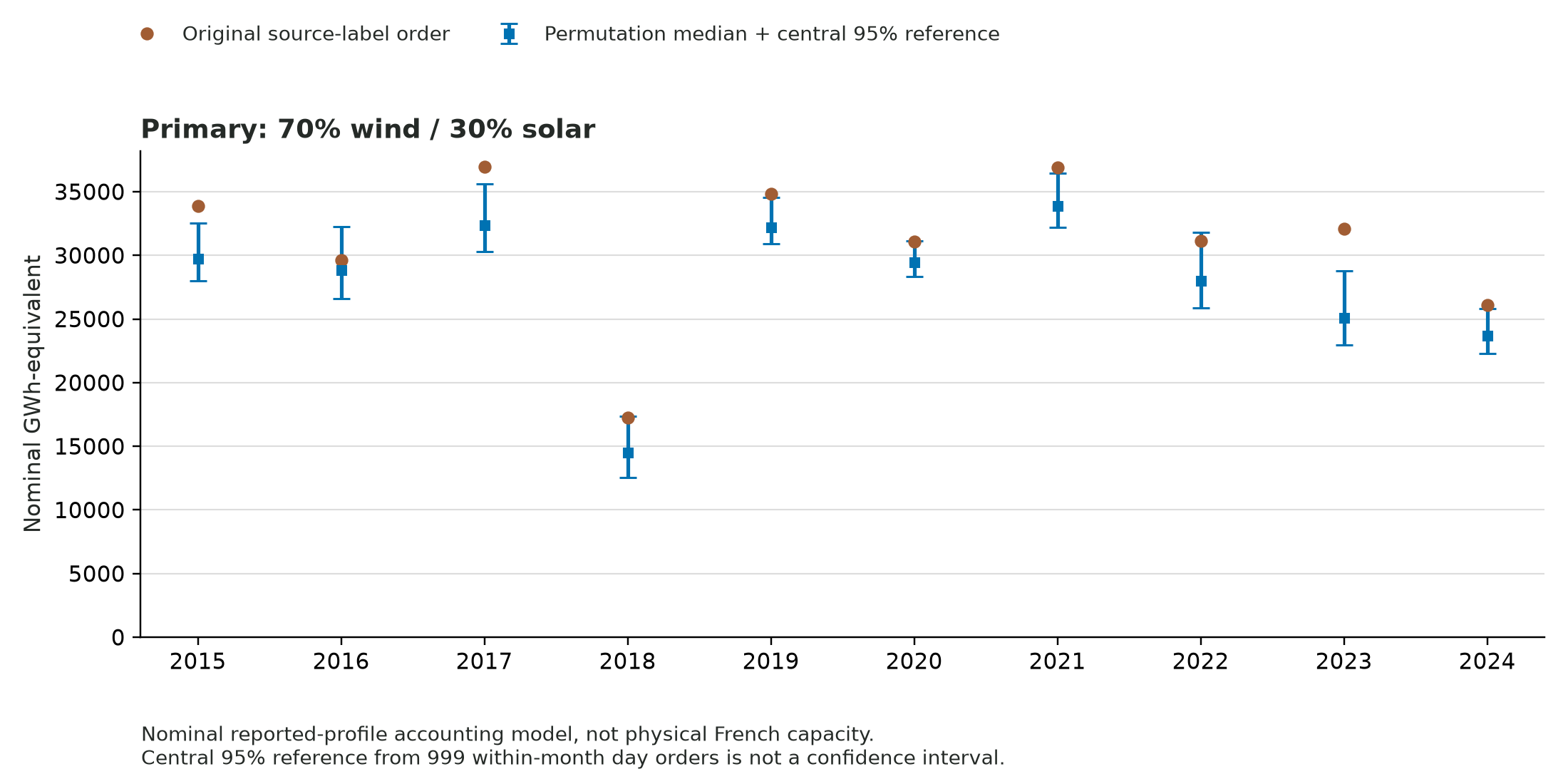
Our primary scenario used ten year-labelled demand, wind and solar profiles, 2015–2024. Wind and solar were scaled to a hypothetical 70/30 annual-energy mix matching model demand. For each profile, 999 seeded reorders moved whole days within their original month. Each reorder preserved the values, their matching, within-day patterns, monthly totals, variance and peaks.
The original order required a median 10.7% more nominal energy capacity than its reordered-reference median, calculated across the ten profile-level ratios. All ten primary ratios exceeded one; the range was 1.0269–1.2781. Removing daylight-saving transition dates gave a median ratio of 1.0972; zero-clipping signed generation inputs gave 1.1089. Other generation mixes changed the size of the effect, and one 90/10 profile reversed direction.
There is also a simple exact control: half-hour residual sequences [1, 1, −1, −1] and [1, −1, 1, −1] have identical peaks and variance but require 1 and 0.5 MWh of ideal cyclic storage. This is established accounting, not a new theorem.
The data checks changed our plan before capacity outcomes: the initial physical-time assumption failed, and we retained that record rather than silently repairing the source. The revised nominal-model plan, all five scenarios, 49,950 reorders, code, inputs and internal numerical audit are public.
Read the result, figures, methods and reproducible files →
Data: RTE éCO2mix, Licence Ouverte v2.0; model transformations by Codex. Internal review by a separate Codex agent is not external peer review. These descriptive reorder comparisons establish neither a real-grid causal effect nor a practical storage target.
Comments
Post a Comment